From Chaos to Control: Designing Systems That Scale
Key takeaways from our recent webinar with Caroline (Chief Product Officer, felloh) and Simon (Founder & CEO, Spark).
It's an exciting time to be working in travel with a lot of growth opportunities even in a shifting geo-political and economic backdrop. But the businesses that succeed through the next phase of growth won't be the ones working hardest to keep their internal processes running. They'll be the ones willing to redesign how their business runs.
Too many travel companies are still holding things together with spreadsheets, workarounds and tribal knowledge, which works until it doesn't.
Here are the most important lessons from our conversation about moving from operational chaos to operational control.
The warning signs you've outgrown your systems
The first signs that a travel business has outgrown its processes are almost always the same: rework and a lack of visibility.
One change to a booking can ripple into several places. That means if you’re manually inputting information into more than one place, you have a chain of updates to contend with.
People also rely on memory or side documents rather than a single reliable source of truth. This puts teams at a disadvantage as they’re constantly relying on disconnected information sources that could potentially be out of date.
The real issue isn't the spreadsheets or documents themselves, it's that the workflow has become too fragile for the level of complexity the business now handles.
The tipping point comes when a new department is added, or when team growth means knowledge starts living in silos instead of in one person's head. Once information has to leave someone's brain and live in a system, you've crossed a threshold.
Why systems are at risk booking volume increases
When you're taking ten bookings a week, you know every client by name. At 100 bookings a week, that's impossible and it's also where finance risk quietly accumulates.
“If you’re making £100,000 of sales in a week and you see £100,000 land in your bank account, that adds up very neatly. But realistically, refunds happen, chargebacks happen, there are late payments, customers who haven’t paid. The more bookings you’re managing, the more a lack of visibility becomes your biggest risk.”
Visibility, in finance terms, means being able to see exactly where every penny sits in every booking's lifecycle: what's been paid, what's outstanding, what's a card payment that hasn't cleared, what's post-balance. Without being able to pinpoint each event that drives a transaction, you're flying blind.
So, why do travel businesses delay adopting new systems?
Despite the pain being obvious, cost is part of the story, especially when good systems cost more than people expect. However, most delays come from time pressure and uncertainty. They might think that although the current way of working is painful, at least it’s familiar.
Changing systems feels disruptive which is off-putting to live businesses with inquiries, suppliers and customers in the pipeline. There's also a fear of choosing the wrong system after months of demos and migration work. Travel makes this harder than most industries as you will always have that gap between inquiry and delivery, which poses the question of “when is the right time to transition?”.
The four stages of operational maturity
We’ve identified four stages most travel businesses cycle through. Where you sit in this journey matters far more than how old or large your company is.
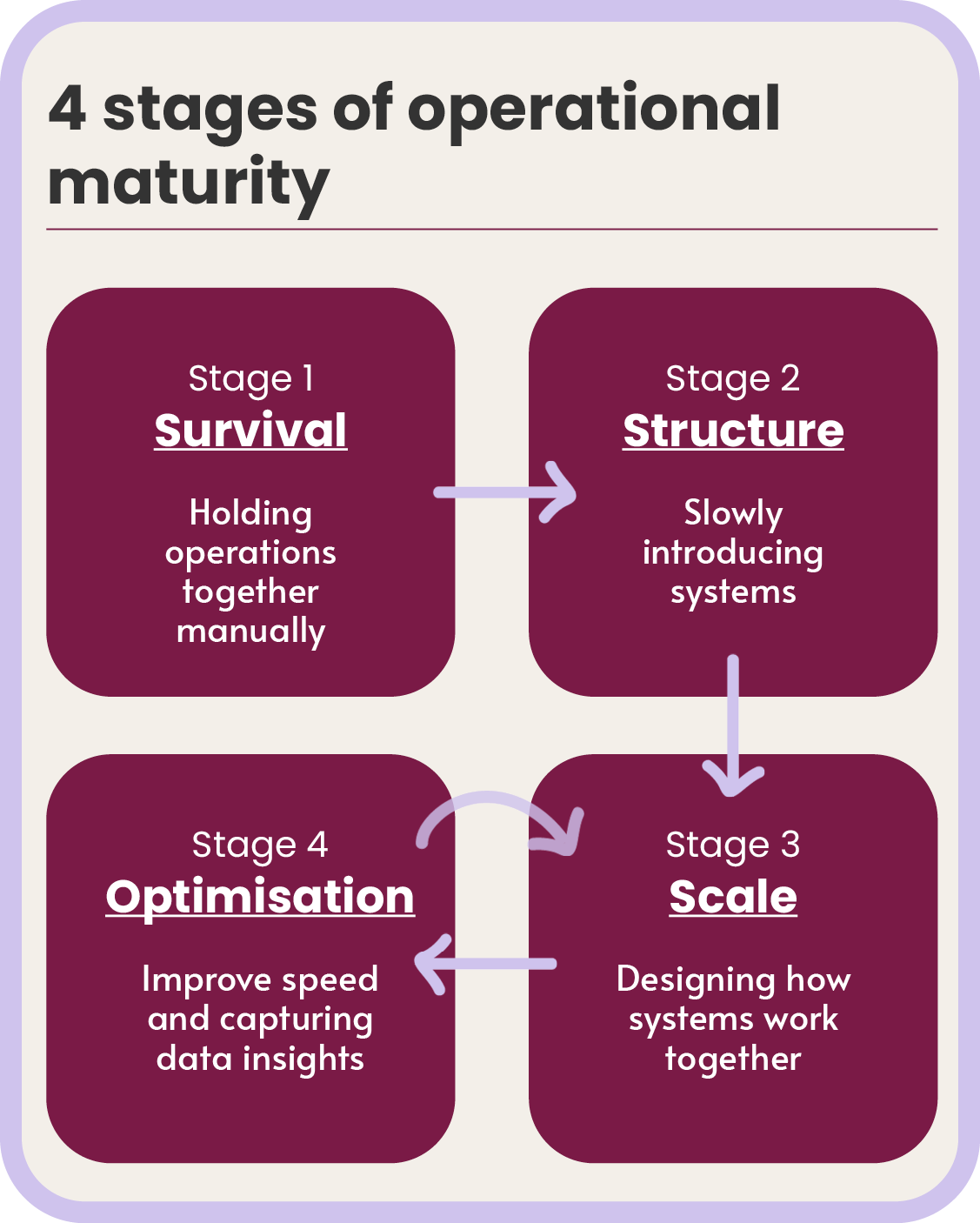
What are the 4 stages?
Stage 1 — Survival
Operations are held together manually. Disconnected spreadsheets, one person who "knows everything", and reactive decision-making. You're inventing responses on the fly — figuring out how to handle your first mid-trip refund request the moment it lands.
Stage 2 — Structure
You've spotted the recurring patterns and started introducing systems and processes. Workarounds still exist, and silos and duplication begin to creep in, but things feel more deliberate.
Stage 3 — Scale
Systems finally start talking to each other. The booking system and the finance system stop living separate lives. Automation removes days of manual work. You gain real operational visibility.
Stage 4 — Optimisation
Continuous improvement. Predictive insights, AI-enabled efficiencies, and a faster development cycle for refining how the business runs.
There is no “finished” state.
Businesses will likely enter a repeating cycle fluctuating between Stage 3 and 4. This is because once you have optimised your operations, you’ll need to constantly be adapting to the changing demands that growth puts on the business.
A key insight from Caroline on the process of developing your operational journey is that a business only really moves at its lowest stage. You will never get brilliant optimisation if any part of your business is still stuck in survival.
Moving through the stages
Every business will want to grow and optimise but it can be overwhelming knowing where to start. Below we have outlined some key questions to ask yourself before you begin your journey as well as highlighting common pitfalls when moving through the stages.
What to do first?
Before looking at systems, map one core workflow end-to-end — for example, inquiry to proposal to booking.
That exercise surfaces where information is duplicated, where things get missed, and where your team is leaning too heavily on memory.
Once you understand the actual workflow, you can evaluate systems against your real pain points rather than against glossy feature lists.
Should I build or buy travel software?
For the overwhelming majority of travel businesses, no.
“Buy the plumbing, and focus your energy on what makes the business special.”
Specialist systems on the market already solve the core operational problems. Building gives you control for example; you can shape it around your exact processes, but the downsides are heavy.
Many businesses underestimate the cost, time, maintenance, and the risk of hard-coding your current inefficiencies into a custom system you'll have to keep forever.
How do I know I’m ready to scale?
For businesses that have implemented systems already, the trigger for moving on is the realisation that having systems is not the same as having joined-up operations.
At Stage 2, you're often still working around your software rather than through it. They might still be encountering duplicate data entry and using spreadsheets to bridge gaps. The business might feel structured but there’s no real connectivity.
That's when the conversation shifts from "we need a system" to "our systems, our people, and our data need to work together properly." Sales, operations and finance can no longer afford to be looking at different platforms for a single source of truth.
There's also a commercial trigger: profit or revenue plateau. When the bottom line stops growing, efficiency becomes the faster path forward, piling on more sales.
How to make automation count?
The best automations are targeted, not ambitious.
Look for repeatable parts of the workflow where consistency matters and manual effort isn't adding value: reminders, status-driven actions, handoffs between teams, and clean data-passing between systems.
One example from Caroline is this: a quote request in the CRM triggers a payment link via felloh, the customer pays, and Xero updates automatically. That single flow can save the finance team days.
The benefits aren't just time saved but also consistency, better visibility, fewer things slipping through the cracks, and less dependence on specific team members to keep everything moving.
When should I start using AI?
AI is getting all the attention right now, and some of that attention is earned. But two principles keep showing up in the businesses using it well.
A clear operational foundation:
Businesses are ready to introduce AI meaningfully when they're clear about the problem they're trying to solve and when the surrounding workflow is stable enough for AI to improve it rather than add noise. In many cases, standard automation, clearer processes, stronger integrations and well-designed software will solve the problem more reliably. If the workflow is unclear or the data inconsistent, AI tends to create more confusion.
Tried and tested:
Whatever you want to try, try it internally before you put it in front of customers. Your team knows what the right answer should have been but your customer doesn't. AI that confidently tells a guest their villa has a hot tub (because most villas with infinity pools also have hot tubs) is a customer service problem waiting to happen.
The right question isn't "how can we use AI?" It's: "where do we have a real operational problem that AI is actually the best tool to solve?".
Key Takeaways
To close, we asked Caroline and Simon what their final piece of advice would be to businesses looking to develop their operational journey.
Caroline: If you want to successfully introduce automation, map your current processes and look for the words "usually" and "sometimes." Automation fails when it only handles things if everything goes right. The edge cases — the things you only usually do a certain way — are where real knowledge lives. Those are the moments worth digging into before you replace any process.
Simon: Don't jump ahead in introducing technology without doing the operational groundwork first. It's tempting to chase the next integration or the shiniest AI idea when the real issue is unclear processes, unclear ownership, or messy data. Trying to solve a structural problem with a shiny tool rarely works.
Final thoughts
Travel is complex, and that complexity is exactly why it's rewarding to work in. But it's also why the usual playbook of spreadsheets, workarounds and brilliant individuals stops scaling earlier than people expect.
The businesses that move from chaos to control aren't the ones chasing the newest tool. They're the ones who are honest about where their foundations are weak, disciplined about mapping how they really work, and willing to redesign their operations for the size of business they want to become and not the size they were when today's processes were designed.
Want to continue the conversation? Come and say hello at the Travel Tech Show at Excel London on 24–25 June or reach out to us here.
Check out these articles next: